
What is Pterygium?
A pterygium (pronounced teh-rij-ee-um) begins on the conjunctiva, the thin membrane that covers the white of the eye. As it grows, it can encroach onto the cornea and, in some cases, affect vision. It often appears as a reddish, slightly raised growth on the inner corner of the eye.
Pterygiums are not cancerous, but they can cause persistent redness, irritation, a gritty or foreign-body sensation, and - if they grow far enough onto the cornea - blurred or distorted vision.
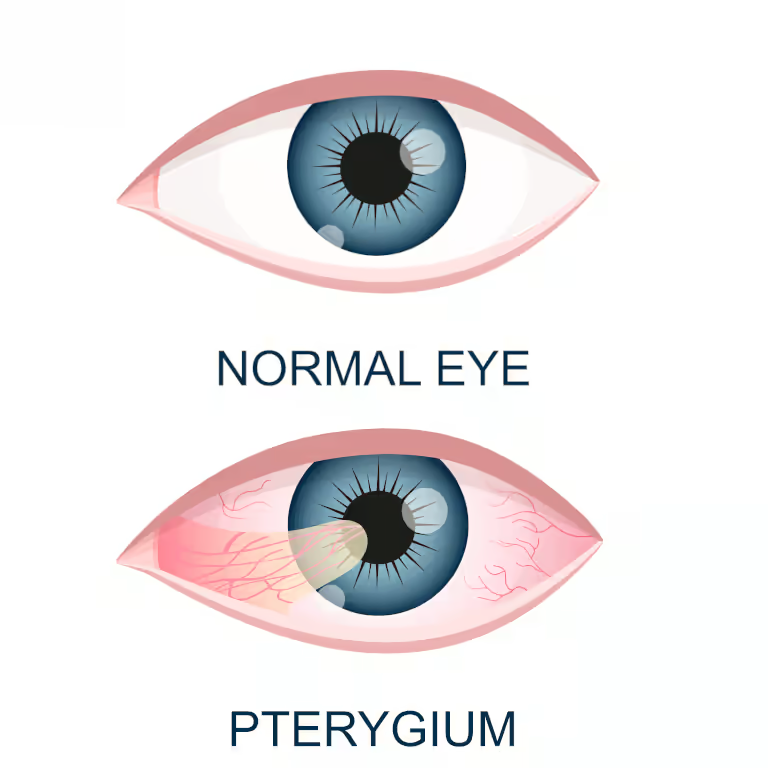
What causes a Pterygium
Prolonged exposure to ultraviolet (UV) light is the most significant risk factor for developing a pterygium. Dust, wind, and dry conditions also play a role. People who spend a great deal of time outdoors - particularly in sunny climates - are more commonly affected. Wearing UV-protective sunglasses and a hat can help limit exposure.

Irritation and blurred vision are common symptoms of Pterygium.
Non-surgical management
Not all pterygiums require surgery. Where a pterygium is small or causing only mild symptoms, conservative treatment may be appropriate. This includes preservative-free lubricating eye drops to reduce irritation, and steroid drops to help manage redness and inflammation. Steroid drops are not suitable for long-term use and would be prescribed and monitored by your treating surgeon.
If your pterygium is growing, significantly affecting your vision, or causing symptoms that are not adequately controlled with drops, your surgeon may recommend surgical removal.
Pterygium surgery: the procedure
At Coastal Eye Surgeons, pterygium surgery involves a single combined procedure: pterygium excision and conjunctival autograft. These two stages are performed together in the same operation - they are not separate or alternative options.
In the first stage, the pterygium is carefully removed from the surface of the eye. In the second stage, a small piece of healthy tissue (the conjunctival autograft) is taken from another part of the same eye and used to cover the area where the pterygium was removed. Performing both stages together is important because it significantly reduces the likelihood of the pterygium returning.
At CES, tissue glue is used to secure the conjunctival autograft - sutures are not required.
Pterygium surgery is performed by Dr Louise Robinson and Dr Liam Turner at Coastal Eye Surgeons.

Where surgery takes place
Pterygium surgery is performed at a day surgery in Southport - not at the Hope Island consulting rooms. Your surgeon will confirm the surgical location and provide instructions specific to your procedure.
What to expect on the day of surgery
Before your surgery, you will need to fast for six hours (no food). Clear fluids are generally allowed up to two hours prior - your surgical team will confirm the exact instructions for you. You should take your normal medications as usual unless your surgeon has told you otherwise, and you will need to arrange for someone to drive you home after the procedure.
At the day procedure unit, eye drops will be used to numb the surface of the eye. The anaesthetist will review your medical history and confirm the type of anaesthetic, which is typically either a local anaesthetic with sedation or a general anaesthetic. You will be positioned under an operating microscope with a bright light overhead. You may be aware of light and movement during the procedure and will be asked to keep still throughout.
Once the procedure is complete, a contact lens is placed over the eye to help with comfort, and a pad and shield are placed before you move to the recovery area. You will be given post-operative drops and instructions before discharge.
If you have difficulty lying flat and remaining still for approximately 30 minutes, please let your surgeon and anaesthetist know in advance.
Recovery after pterygium surgery
Recovery following pterygium surgery involves a course of post-operative eye drops and a schedule of follow-up appointments. Unless your surgeon advises otherwise, the drop schedule is as follows:
- 6 times per day for the first month
- 4 times per day for the second month
- 3 times per day for the third month
- 2 times per day for the fourth month
Your follow-up appointments will be scheduled at:
- Day 1 after surgery
- Day 7 after surgery (at which point the contact lens is removed)
- 1 month after surgery
Your surgeon will give you individual advice about when it is safe to return to driving and exercise.
Can a pterygium come back?
Pterygium recurrence is possible even after surgical removal. The technique used at Coastal Eye Surgeons - excision combined with conjunctival autograft - is specifically chosen to minimise this risk. Your surgeon will discuss recurrence with you as part of your pre-operative consultation.
Risks of pterygium surgery
As with any surgical procedure, pterygium surgery carries risks. These include:
- Infection
- A change in vision (which is generally for the better)
- Recurrence of the pterygium
Your surgeon will discuss these risks with you in detail before your procedure. If you have questions about what to expect, your pre-operative appointment is the right time to raise them.
Appointments and Referrals
Coastal Eye Surgeons sees patients mainly by referral from GPs and optometrists, and we also welcome direct bookings (although you will not be eligible to claim a Medicare rebate).
To request a referral or book an appointment, contact our Hope Island practice.
Hope Island Marketplace
Suite 4, Level 1, 99–103 Broadwater Avenue
Hope Island QLD 4212
Phone: 07 5616 6008
Monday to Friday, 8am–5pm
Additional Resources
- RANZCO patient information
Download PDF information on AMD and a range of other eye conditions - American Society of Retina Specialists (ASRS) – age-related macular degeneration
Learn more about AMD and access printable fact sheets on the condition - Macular Disease Foundation Australia (MDF) – age-related macular degeneration
Access information on AMD from the national peak body representing Australians with macular disease - Vision Australia
Access a wide range of resources and support for low vision